Free OpenAI API alternatives in October 2026 are not all the same kind of free. If you need a recurring zero-dollar developer API, Google AI Studio with the Gemini Developer API is the clearest first-party pick. Anthropic and SpaceXAI (xAI) are mainly prepaid: small signup credits or a free Playground, then metered usage. OpenAI itself also offers a Free usage tier and optional complimentary tokens if you share API traffic—not the same as unlimited free calls.
Facts below come from each lab's own pricing and rate-limit docs, checked on October 10, 2026. Limits, eligibility and model IDs change; re-check the linked pages before you ship.
Free from Ahzy Capital (our own product): The AI Agent Cheat Sheet has 24 copy-paste AI agent setups for 8 types of small business, each with the prompt and the workflow. It's free; Stan asks for your email to send it.
Free OpenAI API alternatives at a glance
| Option | Truly $0 recurring API? | What you actually get | Best for |
|---|---|---|---|
| Google AI Studio / Gemini API | Yes (eligible regions) | Free input and output tokens on listed Flash and other free-tier models; RPM/TPM/RPD caps; free-tier traffic may improve Google products | Prototypes, demos, student projects, light production |
| OpenAI API Free tier + optional data-sharing tokens | Partial | Free tier = up to $100/month usage ceiling in allowed geographies (still needs a positive balance for many paths); optional daily complimentary tokens if you opt in to share traffic | Staying on GPT-6 while testing cheaply |
| Anthropic API | No ongoing free tier | Small one-time free credits for new users; then prepaid token billing (Haiku 5.5 from $0.10 / $0.50 per million input/output) | Trying Claude once, then cheap Haiku workloads |
| xAI API | No free API tokens | Free Playground to try Grok before you buy; API is prepaid credits (grok-4.7 listed at $2 / $6 per million input/output) | Evaluating Grok before paying |
Spoken plainly: "free OpenAI API alternative" usually means Google's free Gemini API key, not a forever-free Claude or Grok production key.
What "free" means for LLM APIs
People searching for an OpenAI API key alternative free often mix four different products:
- Consumer chatbots (ChatGPT Free, Claude Free, Gemini apps) — great for humans, not for your backend.
- Developer free tiers — real API keys with hard rate limits and data-use tradeoffs.
- Signup credits — a one-time balance that runs out.
- Free playgrounds — click-to-try UIs that do not replace production billing.
This guide focuses on developer APIs you can call with a key. For consumer plan pricing (Plus, Pro, Meta One, SuperGrok), see ChatGPT Plus vs Claude Pro vs Google AI Pro and ChatGPT vs Claude vs Gemini vs Grok.
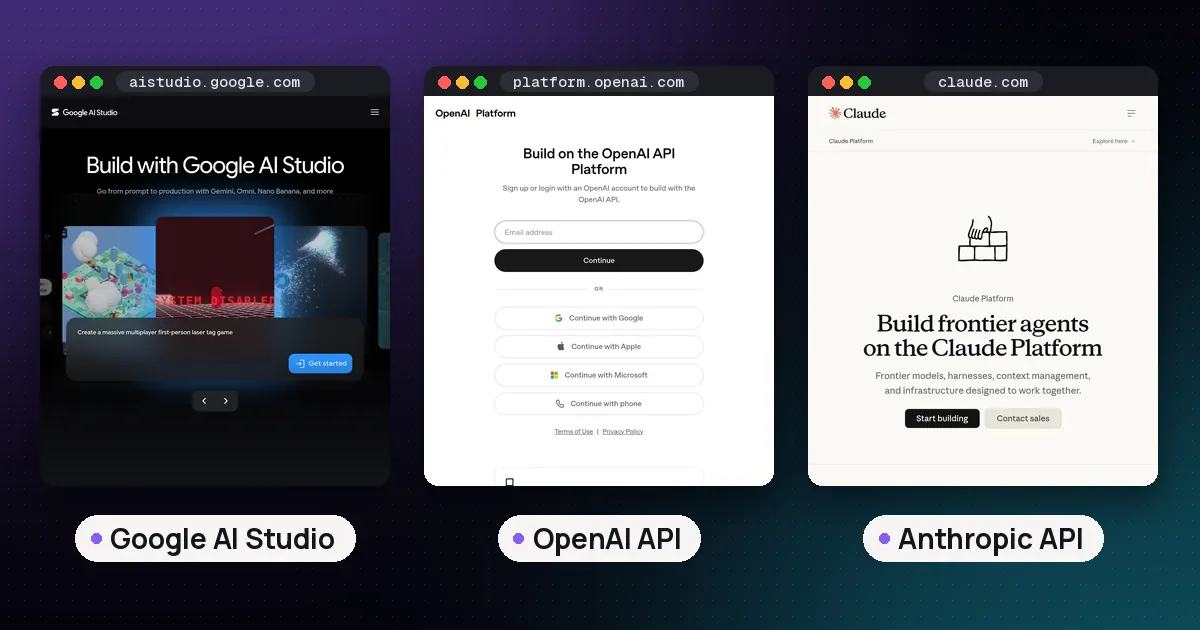
Google AI Studio: the main free OpenAI API alternative
Google AI Studio is Google's developer front door for the Gemini API. Google's pricing page states you can start building free of charge with free input and output tokens on Free-tier models, plus Google AI Studio access, and that Free-tier content may be used to improve Google products. Paid tier traffic is documented as not used to improve products.
That is the practical answer to openai api alternatives free for most builders: create a project in AI Studio, generate a Gemini API key, and call Flash-class models without a card until you hit Free-tier rate limits.
Rate limits and tiers
Google measures Free and paid usage with requests per minute (RPM), tokens per minute (TPM) and requests per day (RPD), applied per project (not per key). RPD resets at midnight Pacific time. Exact Free-tier RPM/TPM/RPD numbers are model-specific and shown live in AI Studio's Rate Limits dashboard; Google warns that published limits are not guaranteed and capacity can vary.
Usage tiers escalate when you link billing and spend:
| Usage tier | Qualification (Google docs) | Role |
|---|---|---|
| Free | Active project or free trial | Zero-dollar API tokens within Free-tier model limits |
| Tier 1 | Link an active billing account | Higher limits; billing tier cap listed at $250 |
| Tier 2 | Paid $100 + 3 days from first successful payment | Higher limits; cap listed at $2,000 |
| Tier 3 | Paid $1,000 + 30 days from first successful payment | Highest standard caps |
Sources: Gemini API pricing and Gemini API rate limits (both updated around October 9, 2026).
Pros
- Real free API tokens on Free-tier Gemini models (including Flash lines with free input/output listed).
- Same AI Studio key path scales into paid tiers when you need production volume.
- Strong multimodal and Google ecosystem fit (Gemini consumer apps share the model family).
Cons
- Free-tier content may be used to improve Google products; paid is the privacy-friendlier path for sensitive prompts.
- Some advanced models and grounding features are paid-only or limited on Free.
- Rate limits can block bursty agents; you must design retries and backoff.
Best for: prototypes, internal tools, coursework, and early products that can live with Free-tier caps.
OpenAI's own "free" paths (still OpenAI)
If the goal is staying on GPT-6 rather than leaving OpenAI, two official paths matter.
Free usage tier
OpenAI's rate-limit docs list a Free usage tier for users in an allowed geography with a $100 / month usage ceiling. Paid tiers then step up with total credit purchases: Build ($5 purchases → $500 / month ceiling), Launch ($100 → $5,000), Grow ($500 → $200,000). The Free row is a ceiling and eligibility bucket—not a promise of unlimited $0 tokens. Practical billing still often requires prepaid credits; exhausted balances return billing errors.
Source: OpenAI rate limits / usage tiers.
Complimentary tokens when you share API traffic
Separately, eligible organizations can opt in to share API inputs and outputs so OpenAI can improve models. Eligible accounts that enable sharing may receive daily complimentary tokens on listed model groups. OpenAI's Help Center documents roughly up to 1M / 10M tokens per day for Launch and Grow (250k / 2.5M for Build) across two model groups, resetting at 00:00 UTC, with overage billed normally. You still need a positive account balance. Fine-tuned models, fine-tuning training, evals and tool use are excluded from the complimentary offer.
Source: OpenAI Help Center — sharing API data and complimentary tokens.
Pros
- Stay on GPT-6 Sol / Luna / Astra without rewriting prompts for another vendor.
- Data-sharing path can offset real cost if your org accepts the privacy tradeoff.
Cons
- Not a drop-in "forever free API key" for production at scale.
- Complimentary tokens require eligibility, opt-in sharing and a positive balance.
- For cheap paid OpenAI inference, many teams still land on GPT-6 Luna pricing rather than Free alone (see Claude Haiku 5.5 vs GPT-6 Luna).
Anthropic API: signup credits, not a free tier
Anthropic's pricing FAQ states plainly: new users receive a small amount of free credits to test the API, and extended trials for enterprises go through sales. There is no documented monthly Free-tier token allowance comparable to Google AI Studio.
After credits, you pay list rates. As of Anthropic's October 2026 price list, Claude Haiku 5.5 is among the cheapest first-party options at $0.10 / $0.50 per million input/output tokens for prompts up to 100,000 tokens (higher rates above that threshold). Sonnet 5.5 is listed at $2 / $10 per million.
Source: Anthropic Claude API pricing.
Pros
- Enough free credit to prove an integration.
- Haiku 5.5 is inexpensive once you pay—useful as a low-cost OpenAI alternative even when it is not free.
Cons
- Not a lasting free OpenAI API alternative.
- Credit amount is not published as a fixed public figure; treat it as a trial, not a budget.
Best for: teams that want Claude quality for writing and long context, and can fund Haiku or Sonnet after the trial.
xAI API: free Playground, prepaid Grok API
SpaceXAI's API page markets a free Playground with every Console account so you can try Grok before writing integration code. API usage itself is usage-based and prepaid: grok-4.7 is listed at $2 per million input tokens and $6 per million output tokens, with full tables in the developer pricing docs. Billing docs describe prepaid credits (and optional monthly invoicing), not a recurring free API token pool.
Sources: x.ai/api, SpaceXAI API pricing, Billing docs.
Pros
- Zero-cost way to evaluate Grok models and Imagine/Voice demos in the Playground.
- OpenAI-compatible base URL path for many SDKs once you buy credits.
Cons
- Not a free production API key.
- Live web/X strengths matter more for product fit than for "free" cost alone.
Best for: trying Grok before you buy; production only after credits.
How to choose among free OpenAI API alternatives
| Your situation | Sensible pick |
|---|---|
| Need a real $0 API key this week | Google AI Studio Free tier |
| Must stay on GPT-6 and can share traffic | OpenAI complimentary tokens (if eligible) + Free/Build tier |
| Must stay on GPT-6 and cannot share data | Buy small OpenAI credits; prefer Luna-class models for cost |
| Want Claude after a short trial | Anthropic signup credits → Haiku 5.5 |
| Want Grok / live search style models | xAI free Playground → prepaid API |
| Comparing consumer chatbots, not APIs | ChatGPT vs Claude vs Gemini vs Grok |
Practical setup checklist
- Decide whether free means $0 forever within caps (Google Free) or cheap enough to start (OpenAI Luna / Anthropic Haiku / xAI prepaid).
- Create the vendor project, enable billing alerts even on Free tiers so a mistaken upgrade does not surprise you.
- Read the Free-tier data-use line: Google Free may use content to improve products; OpenAI API defaults to not training on business API data unless you opt in to share.
- Cap concurrency and add exponential backoff—Free RPM/RPD limits fail loudly under agent loops.
- Re-verify model IDs and prices on the official pages the day you ship; frontier SKUs move quickly.
Pros and cons summary
Google AI Studio (Gemini API Free)
Pros: True free tokens; easy AI Studio onboarding; scales to paid without a new vendor.
Cons: Caps and data-use on Free; some features paid-only.
OpenAI Free tier / complimentary tokens
Pros: Same GPT-6 stack; optional free daily tokens if you share traffic.
Cons: Not unlimited free; eligibility and opt-in required for complimentary tokens.
Anthropic API
Pros: Trial credits; strong Claude models; cheap Haiku after trial.
Cons: No ongoing free tier.
xAI API
Pros: Free Playground; competitive Grok pricing once funded.
Cons: No free API token pool for production.
From Ahzy Capital (our own products, labeled as such): Get the free AI Agent Cheat Sheet: 24 copy-paste AI agent setups for 8 types of small business, with prompts and workflows. Building agents for clients? The AI Agency Playbook ($47) is our 6-module course with client scripts and pricing guidance. We make and sell these, so they aren't independent picks.
FAQ
What is the best free OpenAI API alternative in 2026?
For a recurring free developer API, Google AI Studio's Gemini Free tier is the strongest first-party answer. Anthropic and xAI are better thought of as trial-credit or free-playground paths, then paid APIs.
Is there a free OpenAI API key with unlimited usage?
No reputable first-party lab offers unlimited free production tokens. OpenAI's Free tier has a monthly usage ceiling; Google Free has RPM/TPM/RPD caps; Anthropic and xAI expect payment after trials or Playground use.
Is Google AI Studio the same as Gemini consumer chat?
Related model family, different product. AI Studio / Gemini API is for developers with keys and quotas. The Gemini apps are consumer chat. See also our Gemini tool page.
Does Anthropic have a free API tier?
Anthropic documents small free credits for new API users, not a monthly free token tier. After credits, usage is billed per token.
Can I use the xAI API for free?
You can use the free Playground on console.x.ai to test models. Shipping against the API requires prepaid credits (or invoicing). grok-4.7 list prices start at $2 / $6 per million input/output tokens.
What about openai api alternatives that are open-weight?
Self-hosted open-weight models can be free of vendor token fees but need your own GPUs or a host. That stack sits outside this guide's first-party API focus; intelsi covers frontier hosted APIs and assistants, while open-weight local stacks belong to sibling sites.