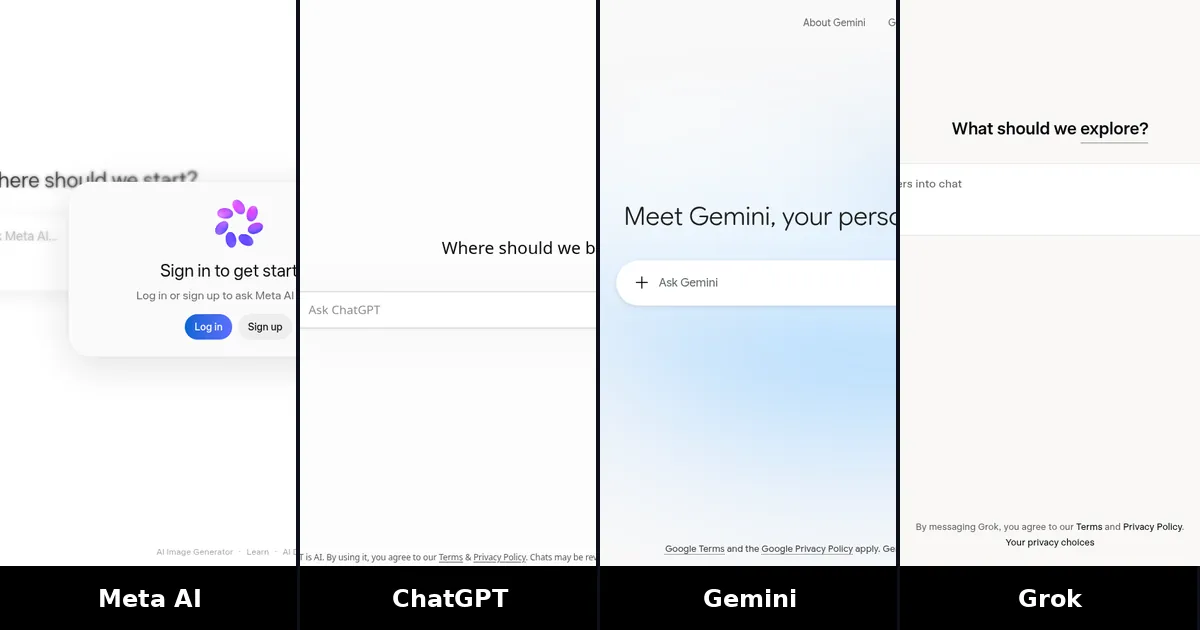
Meta AI vs ChatGPT comes down to where you already spend time. Choose Meta AI when you want a free assistant inside WhatsApp, Instagram, Facebook, Messenger, meta.ai or Meta AI glasses. Choose ChatGPT when you want a standalone workspace for files, deep research, coding agents, custom GPTs and stronger data controls. Neither wins every job.
Facts below are from Meta's and OpenAI's own product pages, checked on October 9, 2026. Plan prices are US list prices; taxes and regional offers vary.
Meta AI vs ChatGPT at a glance
| Item | Meta AI | ChatGPT |
|---|---|---|
| Maker | Meta | OpenAI |
| Consumer models | Muse family (including Muse Spark in Meta AI and apps) | GPT-6 Luna (Free / Go Chat); GPT-6 Sol (Plus and above Chat); GPT-6 Astra on paid tiers |
| Where it lives | WhatsApp, Instagram, Facebook, Messenger, meta.ai, Meta AI app, AI glasses | chatgpt.com, ChatGPT apps, desktop apps |
| Core price | Free for everyday use | Free tier, then Go $8, Plus $20, Pro from $100 |
| Paid upgrades | Meta One Core $7.99, Premium $19.99 (more AI media and app features) | Go, Plus, Pro 100 / 200 / 500; Business and Enterprise |
| Deep research / projects | No ChatGPT-style Deep Research or Projects product | Deep Research, Projects, custom GPTs, Work, Codex |
| Video generation | Yes (higher limits on Meta One) | No Sora consumer video app (closed March 2026); image and Interactive UI remain |
| Training opt-out (US) | No simple US opt-out for Meta AI chats; EU/UK objection forms exist for some training | Settings → Data Controls → turn off "Improve the model for everyone"; Temporary Chat |
Spoken plainly: Meta AI is free and already in the apps billions of people open every day. ChatGPT is a destination product with a clearer free-to-paid ladder and tools built for longer work.
What Meta AI is
Meta AI is Meta's consumer assistant. Meta says the core experience across its apps and Meta AI stays free, and that Meta One subscriptions unlock higher AI usage and expression features on top of that free base, per Meta's Meta One announcement.
You can use it in WhatsApp (including @Meta AI in chats), Instagram, Facebook, Messenger, on meta.ai, in the Meta AI app, and on Meta AI glasses where those products are available. Meta's privacy post states that Meta AI does not join a chat on its own, and in group chats it only reads messages that invoke Meta AI, not the rest of the thread.
Under the hood, Meta's current Muse Spark line is the company's multimodal model family for agentic and coding work. Muse Spark 1.3 is listed with a one-million-token context window on Meta's developer pages at developer.meta.com/ai/models/muse-spark. Consumer Meta AI features and the developer Muse Spark API are related but not identical products: the chatbots in apps are free to try; the API is billed separately.
Best for: quick answers, image and video creation inside Meta apps, help while you are already messaging someone, and people who refuse to open another app.
Watch out for: weaker standalone workspace features than ChatGPT, and privacy defaults that are harder to opt out of in the United States.
What ChatGPT is
ChatGPT is OpenAI's flagship assistant. As of October 7, 2026, the Chat experience runs GPT-6: GPT-6 Sol for Plus, Pro, Business and Enterprise, and GPT-6 Luna for Free and Go, with Intelligent UI rolling out in the Chat tab, according to OpenAI's GPT-6 announcement. Work and Codex keep their own model lineup in that release.
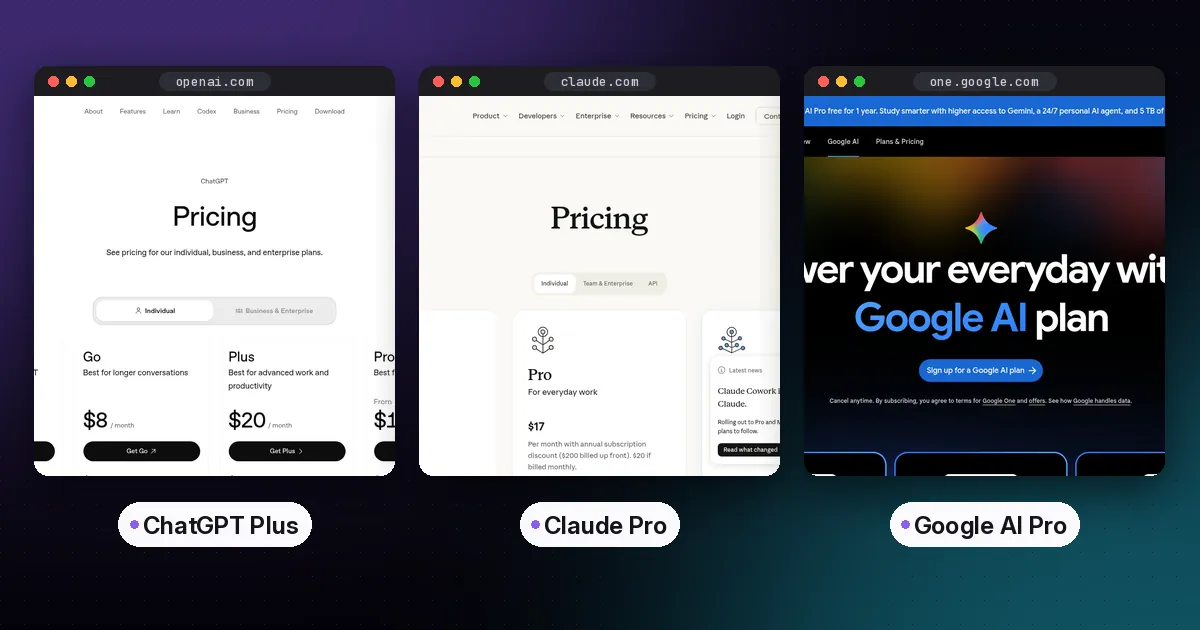
Consumer plans, from OpenAI's pricing and help pages, are roughly:
| Plan | US monthly price | Role |
|---|---|---|
| Free | $0 | Everyday Chat with limits; GPT-6 Luna in Chat as it rolls out |
| Go | $8 | More messages and uploads than Free; ads in some markets |
| Plus | $20 | Advanced reasoning, higher limits, Deep Research, custom GPTs, Codex access |
| Pro 100 / 200 / 500 | $100 / $200 / $500 | Highest included usage; Ultrafast on Pro 500 |
OpenAI introduced Go as a global low-cost tier at $8 in the US; Plus remains $20; Pro tiers are documented in OpenAI's Pro tiers help article. Always re-check openai.com/chatgpt/pricing before you buy, because included models and limits change.
Best for: writing and editing long documents, file analysis, coding, deep research reports, reusable custom GPTs, and workplaces that need Business or Enterprise controls.
Watch out for: Free and Go have tighter limits (and ads in some regions); heavy agent or Pro-model use can consume allowances quickly.
Where they shine (and where they don't)
Everyday chat and messaging
Meta AI wins on friction. If the question lands in WhatsApp or Instagram, you never leave the thread. Meta also says private messages with friends and family are not used to train its generative AI models unless someone shares those messages with Meta AI features, per Meta's generative AI privacy post. Interactions with Meta AI itself may still be used to improve products.
ChatGPT wins when the chat is the work: you want history, projects, exports and a model picker you control.
Work that needs files, research or agents
ChatGPT is the stronger standalone seat. Deep Research, Projects, custom GPTs, scheduled tasks, ChatGPT Work and Codex are built for multi-step jobs. Meta AI is improving agent-style actions and connectors, but it does not match ChatGPT's documented research and builder surface as of this writing.
For how ChatGPT's GPT-6 variants differ, see GPT-6 Sol vs Astra vs Luna. For paid plan comparisons that include Claude and Google, see ChatGPT Plus vs Claude Pro vs Google AI Pro.
Images and video
Meta AI emphasizes free everyday image creation and video generation powered by Muse models, with higher media allowances on Meta One Core and Premium. ChatGPT focuses on image generation and, with GPT-6, Intelligent UI (interactive charts, forms and in-chat tools). OpenAI closed its Sora consumer video app in March 2026, so Meta currently leads on in-product video generation for casual creators.
Privacy and data controls
OpenAI lets ChatGPT users turn off "Improve the model for everyone" under Data Controls, and offers Temporary Chat that is not used to improve models while the chat stays temporary (OpenAI Data Controls, Temporary Chat).
Meta documents that it trains generative AI on public Facebook and Instagram posts and on interactions with AI features, and that private friend/family messages are excluded unless shared with AI. EU and UK users can object to some training uses through Meta's Privacy Center forms. There is no equivalent simple US toggle that matches OpenAI's model-improvement switch for everyday Meta AI chats. If privacy control is the deciding factor, ChatGPT is the clearer choice.
Pricing: free Meta AI vs ChatGPT's ladder
| Need | Sensible pick |
|---|---|
| Free everyday help inside social apps | Meta AI |
| Free standalone chat with stronger work tools | ChatGPT Free (accept limits) |
| Cheap paid bump for more Meta AI media | Meta One Core ($7.99) or Premium ($19.99) |
| Cheap paid bump for more ChatGPT usage | ChatGPT Go ($8) |
| Serious personal work seat | ChatGPT Plus ($20) |
| Maximum ChatGPT usage / Ultrafast | ChatGPT Pro tiers |
Meta One starts at $2.99 for single-app plans and $7.99 for the Core bundle; Premium is $19.99. Meta stresses that Meta AI itself remains free for everyday use. ChatGPT Free stays available; Go sits between Free and Plus.
Meta AI vs ChatGPT vs Gemini vs Grok
If you are comparing more than two assistants:
- ChatGPT — deepest standalone toolkit and GPT-6 lineup.
- Claude — long documents and careful writing (see our four-way chatbot guide).
- Gemini — best when work already lives in Gmail, Docs and Drive.
- Grok — live web and X search; check grok.com/plans for SuperGrok pricing.
- Meta AI — best zero-friction option inside Meta's apps.
Who should pick which
- You live in WhatsApp or Instagram and want free help now: Meta AI.
- You write reports, analyze files or build custom assistants: ChatGPT Plus.
- You care about turning off training on your chats: ChatGPT, with Data Controls and Temporary Chat.
- You want free video and image creation in social apps: Meta AI, then Meta One if you hit free media limits.
- You need workplace admin controls: ChatGPT Business or Enterprise, not Meta AI alone.
- Budget is tight but you want a paid ChatGPT seat: ChatGPT Go before Plus.
FAQ
Is Meta AI better than ChatGPT?
Not overall. Meta AI is better when convenience inside Meta apps matters most. ChatGPT is better for deep work, files, research, coding and privacy toggles. Pick the product that matches the job, not a single winner.
Is Meta AI free?
Yes for everyday use. Meta says the core Meta AI experience stays free. Meta One Core and Premium add higher AI media usage and app expression features on top.
Does ChatGPT Free include GPT-6?
OpenAI began rolling GPT-6 into the Chat tab for Free and Go on October 8, 2026, powered by GPT-6 Luna, after Plus and higher got GPT-6 Sol on October 7. Availability can still depend on rollout and account settings.
Can I use Meta AI without Facebook?
You can open meta.ai and the Meta AI app in supported regions, and WhatsApp includes Meta AI without linking WhatsApp to Facebook account data for AI features, per Meta's privacy post. Exact sign-in requirements vary by surface and country.
Meta AI vs ChatGPT for coding?
ChatGPT is the stronger default today: Codex, custom GPTs and a dedicated coding workflow sit on paid ChatGPT plans. Muse Spark 1.3 is competitive on Meta's developer API for builders, but that is a separate product from chatting with Meta AI in WhatsApp.
Should I pay for Meta One or ChatGPT Plus?
Pay for Meta One if you want more Meta AI image and video generation and Instagram/Facebook/WhatsApp expression features. Pay for ChatGPT Plus if you need Deep Research, higher reasoning limits, custom GPTs and a serious standalone workspace.