Is superintelligence possible? Most leading AI labs and many prominent researchers think so, and several companies now say building it is their explicit goal. Nobody has shown it can be done, though, and no lab claims to have built it as of November 4, 2026. The real disagreement is less about whether a machine could ever outthink people and more about how, how soon, and whether today's large language models are the road that gets there. Even prominent skeptics such as Yann LeCun say smarter than human machines will arrive eventually; they doubt the current approach will produce them.
This guide sets out the strongest arguments on each side, using what the labs and their critics have said in their own words, then covers the limits that could slow things down and why so many people think the question of safety matters more than the question of possibility.
What "superintelligence" means here
The research sense comes from philosopher Nick Bostrom: an intellect that greatly exceeds the best human minds in virtually every domain that matters. Google DeepMind's Levels of AGI paper puts Artificial Superintelligence in the top cell of its matrix, where performance is superhuman and general. A system that is superhuman at one task, like AlphaFold at protein structure prediction, does not count.
That makes superintelligence a step beyond AGI, which usually means roughly human level skill across most cognitive work. Our superintelligence vs AGI guide compares the two definitions in detail. It is also different from the US government's new "SI" label, which renames federal AI policy rather than describing a system that exists; see what SI means instead of AI.
Is superintelligence possible? The short answer
| Question | Where the evidence points (Nov 2026) |
|---|---|
| Possible in principle? | Most lab leaders and many researchers say yes; few argue it is physically impossible |
| Already here? | No. No lab has declared it, and even the AGI label is disputed |
| Possible with today's LLMs? | Contested. OpenAI and Anthropic leaders expect current methods to go far; LeCun says a new paradigm is needed |
| Inevitable? | Not settled. It depends on research breakthroughs, compute, energy and policy choices |
| Dangerous? | Many lab CEOs and leading scientists have signed statements treating extinction level risk as serious |
The case that superintelligence is possible
The labs say it is their goal. In The Gentle Singularity (June 2025), OpenAI CEO Sam Altman wrote that "humanity is close to building digital superintelligence" and called OpenAI "a superintelligence research company." He also admitted the limits of anyone's knowledge: "We do not know how far beyond human level intelligence we can go, but we are about to find out."
Meta made the same bet public. In his Personal Superintelligence letter of July 30, 2025, Mark Zuckerberg wrote that "developing superintelligence is now in sight" and said Meta had seen "glimpses of our AI systems improving themselves," slow for now. Our guide to Meta Superintelligence Labs covers what that division is building.
Then there is a company named for the goal. Safe Superintelligence Inc. (SSI), which former OpenAI chief scientist Ilya Sutskever co-founded with Daniel Gross and Daniel Levy in June 2024 (TechCrunch), opens its site with "Superintelligence is within reach" and says a safe superintelligence is its only product.
Capability has kept climbing. The pro side points to a run of systems that now match or beat skilled people on many narrow tasks, plus the use of AI to speed up AI research itself. Altman calls that "a larval version of recursive self improvement." Our explainer on how autonomous frontier AI models are sets out what the labs' own system cards say about self improvement thresholds so far.
Brains are proof that general intelligence can run on physical hardware. This is the philosophical core of the argument. If human intelligence comes from physical processes, there is no known law that caps machine intelligence at the human level. Anthropic CEO Dario Amodei, in Machines of Loving Grace (October 2024), describes "powerful AI" that would be "smarter than a Nobel Prize winner across most relevant fields," running as millions of copies, a "country of geniuses in a datacenter." He wrote that it "could come as early as 2026, though there are also ways it could take much longer."
The case for skepticism
Today's architecture may hit a ceiling. Yann LeCun, the Turing Award winner who spent years as Meta's chief AI scientist and now chairs AMI Labs, is the best known voice here. At Davos in January 2026, Fortune reported, he argued that the LLMs behind all the leading models will never reach humanlike intelligence and that a completely different approach is needed. The Indian Express quoted him: "We're not going to get to human level intelligence or superintelligence by scaling up or refining the current paradigm." Notice what he is not saying. In the same talks he says machines smarter than humans will come, just not from LLMs and not in the next year or two. Our AGI vs LLM guide explains why the architecture question matters.
Intelligence is not magic. Amodei, who expects powerful AI soon, is also one of the clearest writers on its limits. He lists the speed of the physical world, the need for data, intrinsic complexity, human constraints and physical laws as factors that cap what extra intelligence can achieve. "Intelligence may be very powerful, but it isn't magic fairy dust," he wrote. That argument does not say superintelligence is impossible. It says a superintelligent system would still wait on experiments, factories and regulators, which undercuts the idea of an overnight "singularity."
Definitions keep moving. Each time a benchmark falls, the goalposts tend to move. In September 2026, OpenAI president Greg Brockman said he personally thought GPT-6 Astra might mark the arrival of AGI, while other researchers and the ARC Prize team disagreed. If the field cannot agree on whether AGI is here, a claim of superintelligence will be even harder to settle. Our has AGI been achieved guide covers that fight.
Promises have slipped before. OpenAI's 2023 Superalignment announcement said superintelligence "could arrive this decade" and set a four year goal for solving its alignment. Timelines from people building the technology are forecasts, not evidence, and they come from companies raising money on them.
Pros and cons of each view
"It's coming soon" view
Pros:
- Matches the stated plans and spending of OpenAI, Meta, SSI and others
- Fits the steady rise in measured capability and AI assisted research
- Encourages early safety and policy work
Cons:
- Rests on extrapolation; no system has shown superhuman general ability
- Comes largely from companies with a financial stake in the story
- Earlier timelines have slipped
"Not with current methods" view
Pros:
- Points to real gaps in planning, memory and understanding of the physical world
- Backed by a Turing Award winner with decades in the field
- Explains why benchmark wins don't always carry over to messy real tasks
Cons:
- Similar predictions about LLM limits have been overtaken before
- Doesn't say when a new paradigm would arrive, so it gives little guidance on risk
- Still concedes that superintelligence is possible eventually
Is superintelligence inevitable?
No serious source can promise that. Amodei calls the basic development of AI "inevitable (unless the risks derail everything)" because powerful market forces drive it, but he stops short of putting a date on superintelligence. LeCun treats it as certain eventually but far from imminent. And policy could change the pace: the Future of Life Institute's Statement on Superintelligence calls for "a prohibition on the development of superintelligence, not lifted before there is broad scientific consensus that it will be done safely and controllably, and strong public buy in." Its signers include Geoffrey Hinton, Yoshua Bengio and Stuart Russell. Russell describes it as "not a ban or even a moratorium in the usual sense," but a demand for adequate safety measures. Whether governments act on calls like that is one of the biggest unknowns.
Is superintelligence dangerous?
The people closest to the technology are among the most worried. OpenAI's Superalignment post said superintelligence "could help us solve many of the world's most important problems" but also "could lead to the disempowerment of humanity or even human extinction." It admitted that current alignment techniques, which rely on humans supervising AI, "will not scale to superintelligence."
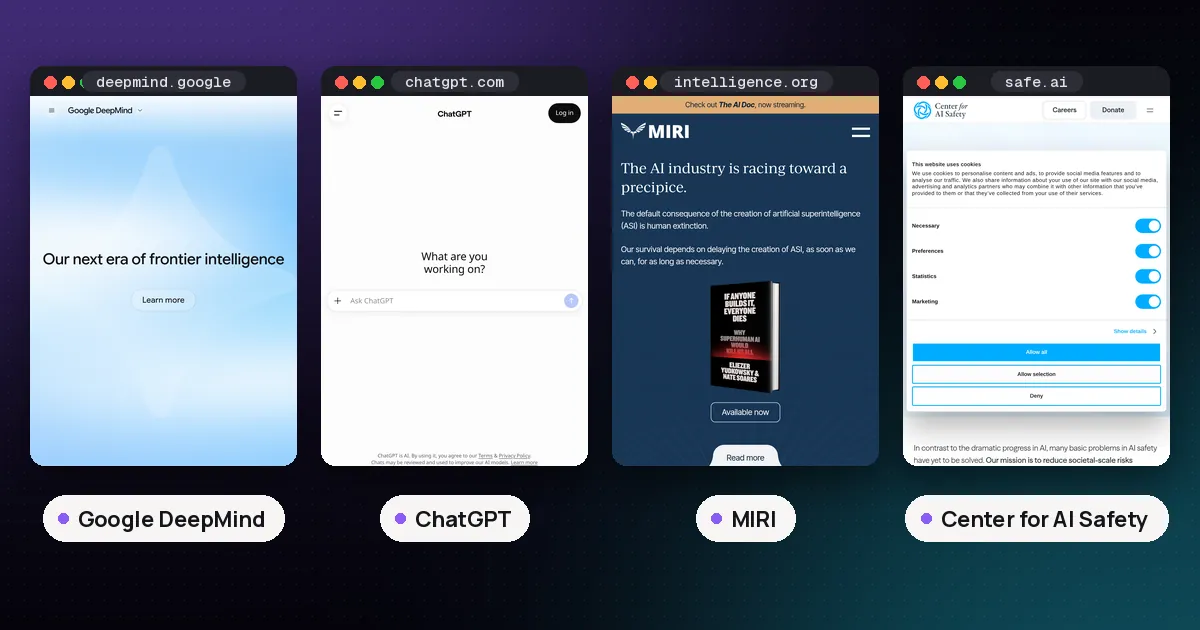
In 2023 the Center for AI Safety published a one sentence Statement on AI Risk: "Mitigating the risk of extinction from AI should be a global priority alongside other societal scale risks such as pandemics and nuclear war." Signers include Altman, Amodei, Google DeepMind CEO Demis Hassabis, Hinton, Bengio and Sutskever. Research groups such as MIRI go further and argue the race itself is reckless. Our what is AI safety guide explains the research agenda, and pace the frontier covers Anthropic's argument for keeping safety work ahead of capability.
| Risk raised | Who has raised it |
|---|---|
| Loss of human control or extinction | OpenAI Superalignment post; CAIS statement signers; FLI statement |
| Alignment methods that don't scale | OpenAI Superalignment post |
| Concentration of power | Altman (warns against superintelligence being "too concentrated"); Zuckerberg (prefers personal over central control) |
| Job loss and economic disruption | Altman ("whole classes of jobs going away"); FLI statement ("human economic obsolescence") |
Is superintelligence already here?
No. ChatGPT, Claude, Gemini and Meta AI are general products with uneven skills: excellent at some writing, coding and analysis, unreliable at others, and still supervised by people. That fits DeepMind's description of "Emerging AGI" far better than a system that greatly exceeds every expert in every field. Altman has written that "in some big sense, ChatGPT is already more powerful than any human who has ever lived," meaning its reach across hundreds of millions of users, not that it outthinks the best humans at everything.
How to judge new superintelligence claims
- Check the definition. Is the claim about narrow superhuman skill, AGI, or general superintelligence?
- Look for independent evaluation. A lab announcement is not proof. Look for testing by outside evaluators and published system cards.
- Separate products from capability. A division named "Superintelligence Labs" or a model named for it has not built it.
- Watch the physical bottlenecks. Real world impact still depends on experiments, hardware and energy.
- Read the safety section. How a lab says it would control a much smarter system says a lot about how seriously it takes the goal.
FAQ
Is superintelligence possible at all?
Most lab leaders and many researchers say yes in principle, because nothing known about physics limits machine intelligence to the human level. What remains unproven is whether anyone can build it and when. Even skeptics like Yann LeCun expect smarter than human machines eventually.
Is superintelligence inevitable?
Not settled. It depends on research breakthroughs, compute and energy, and on whether governments slow development. The Future of Life Institute's Statement on Superintelligence calls for a prohibition until there is scientific consensus that it can be done safely and strong public buy in.
Is superintelligence dangerous?
Many of the people building it say it could be. OpenAI has written that it could lead to human disempowerment or extinction, and the CEOs of OpenAI, Anthropic and Google DeepMind signed a 2023 statement calling extinction risk from AI a global priority.
Is superintelligence real or just hype?
No superintelligence exists yet, so in that sense it is a goal, not a product. It is real as a research target and a business plan: OpenAI calls itself a superintelligence research company, Meta has a superintelligence division, and SSI exists only to build one.
Can large language models become superintelligent?
That is the core dispute. Altman and Amodei expect methods close to today's to go very far, while LeCun argues LLMs lack world models, memory and planning and that a new paradigm is required.