The Ban Artificial Superintelligence Act is a bill in Congress that would permanently outlaw artificial superintelligence in the United States, pause work on every large AI model until a new federal regulator writes safety rules, and create a cabinet level Department of Artificial Intelligence to license and inspect AI labs. Senator Bernie Sanders introduced it in the Senate as S. 5493 on September 23, 2026, and Representative Greg Casar introduced the matching House bill, H.R. 10538, the next day. As of November 12, 2026 it has not had a hearing or a vote in either chamber. It is back in the news because Democrats won control of Congress on November 3 and some of the bill's backers now say a pause should be the first item on the new majority's agenda.
Below: what the bill text says, who backs it, what critics object to, and what would have to happen for it to become law. Facts come from the bill text on GovInfo, Congress.gov records and the sponsors' releases, checked against news coverage.
Ban Artificial Superintelligence Act at a glance
| Question | Short answer |
|---|---|
| Bill numbers | S. 5493 (Senate) and H.R. 10538 (House), 119th Congress |
| Introduced | September 23, 2026 (Senate) and September 24, 2026 (House) |
| Lead sponsors | Sen. Bernie Sanders (I, Vermont) and Rep. Greg Casar (D, Texas) |
| House cosponsors | 12 as of November 12, 2026 |
| Senate cosponsors | None listed |
| Committees | Senate Commerce, Science, and Transportation; House Oversight and Government Reform |
| Status | Referred to committee, no hearing or vote yet |
| Core idea | Ban superintelligence outright, pause large models until a new department sets rules |
| Compute trigger | Models trained with 10^25 or more operations, adjusted each year |
| Top penalty | Up to 20 years in prison for certain reckless violations |
The two versions are word for word the same apart from formatting. You can read the House text on GovInfo and the Senate text in the S. 5493 PDF.
What the Ban Artificial Superintelligence Act would ban
Section 9 says no person may develop, deploy (inside a company or to the public), acquire, possess, fund, import or transfer artificial superintelligence. The ban also covers any AI system that shows even one "superintelligence precursor characteristic," and any system that could foreseeably be modified to produce one.
The bill defines artificial superintelligence as a system that exhibits, or can easily be modified to exhibit, either of two things: performance that exceeds human cognitive ability across most domains or tasks, or enough capability to plan and carry out the destruction or disempowerment of humanity, including by overthrowing or undermining the federal government. For background on where these terms come from, see our guides to superintelligence vs AGI and whether superintelligence is possible.
The six precursor characteristics in Section 3 are the part that matters most in practice, because they reach far below true superintelligence:
- Automating or greatly speeding up AI research and development.
- Getting into secured computer systems or physical infrastructure without authorization.
- Keeping itself running despite attempts to shut it down.
- Helping people design, make or obtain nuclear, chemical or biological weapons.
- Independently modifying or enhancing its own functions.
- Scheming, deceiving or otherwise avoiding human oversight.
Frontier labs already test for several of these. Automated AI research is what METR measured in its Anthropic acceleration report.
The pause on advanced AI and the 10^25 threshold
Section 8 puts every "advanced artificial intelligence system" under a mandatory pause starting the day the law takes effect. An advanced system is one trained with 10^25 or more integer or floating point operations. Each year the new Secretary of Artificial Intelligence must adjust that number so it keeps pace with more efficient training methods.
During the pause, covered systems may not be trained, modified or fine tuned, including through recursive self improvement, except to remove precursor characteristics or to switch the system off. No unreleased advanced system may be deployed. The pause ends only when the Secretary decides the department is fully staffed and has issued rules that cover four things:
- Reporting of development plans to the department before work starts
- Monitoring and evaluation through development, deployment and after release
- Audits of each company's safety practices
- Final approval by the department before any advanced system is released
The bill sets no deadline, so the pause lasts as long as a brand new department takes to hire staff and write rules.
For comparison, the same 10^25 figure appears in the EU AI Act. Under Article 51, a general purpose model trained with more than 10^25 floating point operations is presumed to have "high impact capabilities" and faces extra obligations. The EU uses the number to trigger paperwork and testing. This bill uses it to trigger a stop.
The new Department of Artificial Intelligence
Sections 4 to 7 create an executive department led by a Secretary of Artificial Intelligence, appointed by the President with Senate confirmation. Its stated purpose is to protect the public from the dangers of AI, "including by enforcing a pause on development of advanced artificial intelligence and a prohibition on artificial superintelligence."
| Power or duty | What the text says |
|---|---|
| Charters | Nobody may develop or distribute an advanced model without a charter from the Secretary (Section 12) |
| Access | Charter holders must give the Secretary full access to systems, processes, staff and physical infrastructure |
| Monitoring | The department evaluates advanced systems, and models distilled from them, before, during and after training and after release |
| Approval | No advanced system may be released without the department's approval; it must be withheld if dangerous traits are found |
| Shutdown | A system with precursor traits is paused and cut off from the internet at once, and switched off within 30 days unless it is verified clean |
| Destruction | A system identified as superintelligence must be rendered inoperative immediately |
| Disclosure | Anyone who discovers a superintelligent system, or one with precursor traits, must tell the Secretary within 24 hours |
| Advice | An Artificial Intelligence Advisory Board of experts chosen by the Secretary |
Section 15 directs the Secretary and the Secretary of State to pursue international agreements against superintelligence, possibly backed by export controls on AI computing infrastructure.
Penalties in the bill
Section 13 sorts people into three groups and punishes reckless violations of the pause, the ban or the charter rule differently for each.
| Who | Penalty for a reckless violation |
|---|---|
| People in policymaking roles at a chartered company | Federal fine and up to 20 years in prison |
| "Rogue actors" with no chartered company | Federal fine and up to 20 years in prison |
| Other employees of a chartered company | Barred from working in the AI industry for 10 years (can appeal; whistleblowers can get a waiver) |
| The company itself | Charter revoked; after a failed appeal to the Federal Circuit, its intellectual property and assets are forfeited |
The sponsors' one page summary calls the company outcome the "corporate death penalty" and compares the 20 year maximum to existing penalties for unlawfully building nuclear weapons. Section 14 protects whistleblowers from retaliation.
Who supports the bill
The House version had 12 cosponsors as of November 12, according to Congress.gov: nine Democrats at introduction, including Ro Khanna and Yassamin Ansari, then Alexandria Ocasio-Cortez (September 28), Emily Randall (October 1) and Paul Tonko (October 13). The Senate version has none.
Sanders first announced the plan on September 3, 2026. The bill's findings quote warnings from Geoffrey Hinton, Dario Amodei, Elon Musk, Sam Altman and others, and cite the idea that labs should "pace the frontier," which we explain in our guide to Amodei's pace the frontier plan. NBC News reported praise from the advocacy group ControlAI, and outlets including Fortune and The Next Web reported that some employees at AI companies endorsed it.
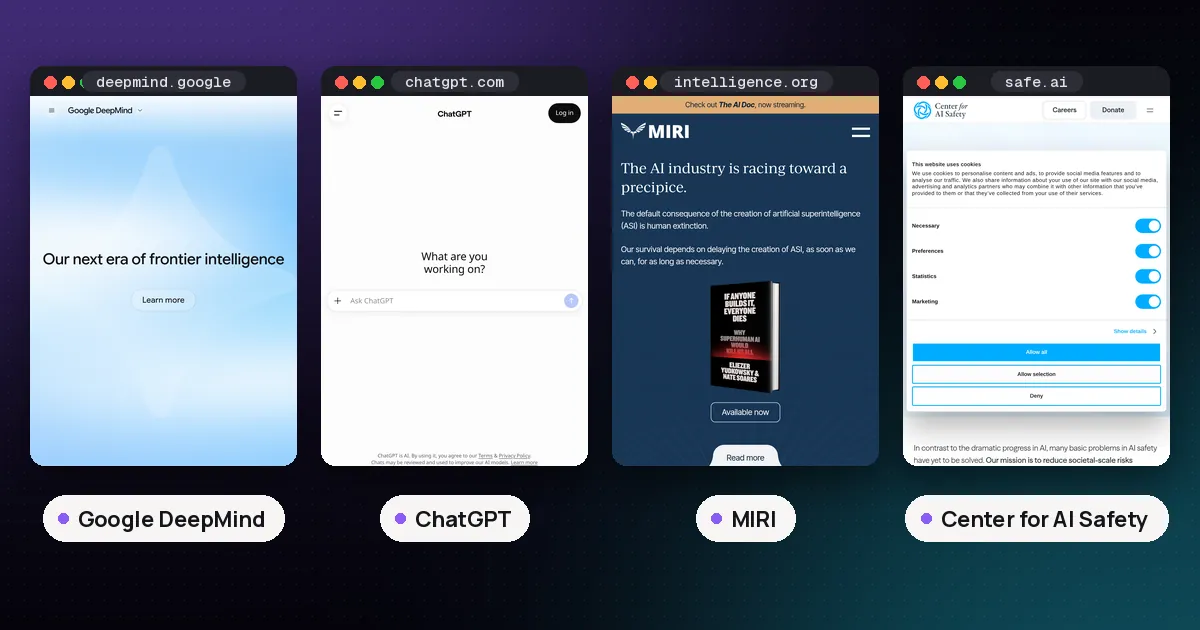
The bill also lines up with the Statement on Superintelligence organized by the Future of Life Institute, which calls for a prohibition on developing superintelligence until there is broad scientific consensus it can be done safely and strong public buy in. That statement showed 78,623 signatures when we checked on November 12. Groups such as MIRI and the Center for AI Safety have long argued that superintelligence poses extinction level risk, which is the premise the bill starts from.
What critics say
- Industry groups: Caleb Max of the National AI Association told NBC News the bill would be "dead on arrival" and that some CEOs would say current models already cross its threshold, "meaning this is a de facto AI ban."
- Free market think tanks: the R Street Institute called it "AI authoritarianism" and said its core terms are vague.
- Some AI risk voices: Gary Marcus, who has long backed an AI agency, wrote that a permanent, unilateral ban "is too broad" even if a temporary pause might make sense.
- Other Democrats: a Democratic staffer told Semafor they doubted Democrats in both chambers would broadly support a pause like Casar's.
Pros and cons
| Pros (as supporters see it) | Cons (as critics see it) |
|---|---|
| Treats extinction level risk as a legal matter, not a voluntary pledge | The pause has no end date and depends on a department that does not exist yet |
| Defines danger by concrete capabilities such as evading shutdown | Precursor traits like faster AI research may already describe today's models |
| Requires government approval before release, with real inspection powers | Charters, full access and forfeiture give one official very broad power |
| Protects whistleblowers inside AI companies | A US only stop could leave development to other countries |
Will the Ban Artificial Superintelligence Act pass?
Probably not in its current form, and not this year. The bill sits in committee with no hearing scheduled. The 119th Congress ends in early January 2027, and any bill that has not passed both chambers by then dies and must be reintroduced in the new Congress.
What changed is the politics. After the November 3 midterms, CNBC reported that Representative Yassamin Ansari posted that pausing AI development should be a day one priority for the new House majority, and that Casar replied "Yes!" CNBC's voter poll found 56% of voters called AI and data centers a crucial or major factor in their vote. Reason and Futurism revived the story on November 11.
Even with Democratic majorities, the bill would need to clear committees in both chambers, pass the Senate, and get the signature of President Trump, whose administration has favored a light touch approach to AI. His EO 14434 renamed AI "Super Intelligence" in federal usage, and his National AI Policy Framework asks Congress to preempt many state AI laws rather than add new federal limits. Expect hearings and a reintroduced bill in 2027 before any vote. Some advocates are not waiting for Congress: on November 12, four nonprofits asked a San Francisco court to freeze frontier development under existing state law, as our guide to the nonprofits' lawsuit against AI companies explains.
How it compares with other AI rules
| Rule | Type | What it does to frontier labs |
|---|---|---|
| Ban Artificial Superintelligence Act | Proposed US federal law | Bans superintelligence, pauses models at 10^25 operations, requires licenses and approval |
| EO 14434 | US executive order (in force) | Changes federal terminology from AI to SI; no new limits on labs |
| National AI Policy Framework | White House recommendations | Asks Congress for one national law that preempts many state rules |
| EU AI Act, Article 51 | EU law (in force) | Extra obligations for models above 10^25 FLOPs, but no ban |
| Lab safety frameworks | Voluntary company policies | Self imposed capability tests and safeguards, as in our Preparedness Framework vs Responsible Scaling Policy guide |
If you mainly want to understand the safety arguments behind all of this, start with our explainer on what AI safety is.
FAQ
Is the Ban Artificial Superintelligence Act law?
No. As of November 12, 2026 it is only a proposal. Both versions were referred to committee in September 2026 and neither has had a hearing or a vote.
What does the Ban Superintelligence Act do in one sentence?
It would ban superintelligent AI permanently, freeze work on large AI models until a new Department of Artificial Intelligence writes safety rules, and require labs to get a federal charter and approval before building or releasing advanced models.
Would the bill stop ChatGPT, Claude or Grok?
It could. The pause covers any system trained with 10^25 or more operations, so the frontier models behind ChatGPT, Claude and Grok would likely need charters and approval. The text names no product; the new department would decide which models cross the line.
Is this the same as the superintelligence statement petition?
No. The Statement on Superintelligence is a public letter organized by the Future of Life Institute that anyone can sign. The bill is legislation. They share the goal of prohibiting superintelligence until it can be shown to be safe, but the statement has no legal force.
What is the Department of Artificial Intelligence?
The cabinet level agency the bill would create, led by a Senate confirmed Secretary. It would issue charters, approve models before release, run the pause and shut down dangerous systems. It does not exist today.