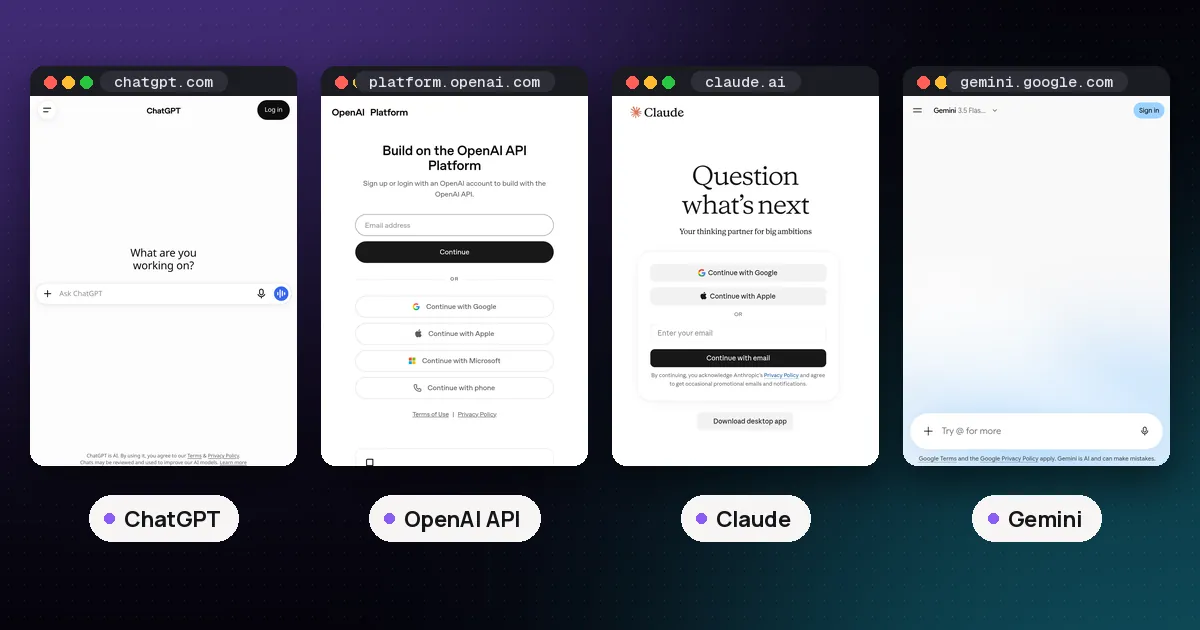
What is a frontier model? It is a highly capable general purpose AI model at or near the leading edge of what labs can build today: a system that can handle a wide range of tasks and that matches or beats the most advanced models already in wide use. The label is relative, not a fixed score. As new models ship, yesterday's frontier system can become ordinary. You usually meet one through an assistant such as ChatGPT, Claude, Gemini or Grok, not by downloading the raw model.
This guide sets out how labs, an industry group, the UK government and California law define the term, how a frontier model differs from a foundation model, and what a frontier model company is. Facts were checked on November 7, 2026 against the cited primary pages. Nothing here was tested first hand.
What is a frontier model in AI?
In AI, "frontier" names the current leading edge of general purpose models. It is not a permanent product class. Stanford HAI describes a frontier model as a highly capable, general purpose AI model at or near the leading edge of AI development. Unlike a narrower system built for one job, it can handle a broad range of complex tasks and usually takes substantial data and computing resources to train.
Google DeepMind is more direct on its frontier safety page: "We call our most powerful foundation models ‘frontier models’." That treats frontier models as a subset of foundation models, and it ties the label to power relative to the rest of the lab's lineup.
Three traits show up across the main definitions:
- Generality. The model can do many kinds of work (writing, coding, analysis, images or tool use), not one narrow task.
- Leading capability. It matches or exceeds the most advanced models already in wide use, or it is among a lab's most powerful systems.
- A moving line. The set of frontier models changes as the field progresses.
| Question | Short answer |
|---|---|
| What is it? | A highly capable general purpose AI model at or near today's leading edge |
| Is the label permanent? | No. The frontier moves when stronger models ship |
| Single official test? | No. Some definitions use capability. California uses training compute |
The UK's 2023 AI Safety Summit discussion paper, updated on April 28, 2025, defined frontier AI as highly capable general purpose AI models that can perform a wide variety of tasks and match or exceed the capabilities present in today's most advanced models. It left out powerful but narrow systems such as AlphaGo, AlphaFold and DALL·E 3. Emerging processes for frontier AI safety uses the same glossary and calls a developer of such systems a frontier AI organization.
Frontier model vs foundation model
The two names are related, but they answer different questions.
A foundation model is defined by how it is built and how it can be reused. NIST describes foundation models, citing NIST AI 100-2e2025, as models trained on broad data using self supervised learning that can be adapted, such as through fine tuning, for a variety of later tasks. California's Business and Professions Code section 22757.11 uses a similar three part test: trained on a broad data set, designed for generality of output, and adaptable to a wide range of distinctive tasks.
A frontier model is defined by how capable it is compared with other systems, or, in California, by how much computing power was used to train a foundation model. The Frontier Model Forum says frontier AI refers to general purpose models that constitute the state of the art, a collection that will shift over time. For membership, it counts a model as frontier if it outperforms, on ordinary benchmarks or high risk capability tests, every other model that has been widely deployed for at least 12 months. More than one lab can sit at the frontier at once.
In practice, every frontier model discussed in 2026 policy is a kind of foundation model, or is built on one, but most foundation models are not frontier models. A smaller general model, an older flagship or a brilliant narrow system can sit outside the leading edge. If you are asking whether a model can be adapted to many tasks, you are asking about a foundation model. If you are asking whether it is among the most capable general systems anyone has deployed, you are asking about a frontier model.
How labs and governments define a frontier model
There is no single global test. Definitions use capability relative to other models, a lab's own most powerful foundation models, or a legal compute threshold.
| Source | Kind of test | What it says, in short |
|---|---|---|
| Stanford HAI glossary | Capability | Highly capable, general purpose, at or near the leading edge |
| Frontier Model Forum | Capability vs recent deployments | Outperforms models widely deployed for at least 12 months |
| Google DeepMind | Lab ranking | The lab's most powerful foundation models |
| UK AI Safety Summit papers | Capability | Highly capable general purpose models that match or exceed today's most advanced models |
| California Transparency in Frontier Artificial Intelligence Act | Training compute | A foundation model trained with more than 10^26 operations, including later material modifications |
The Forum first defined frontier models on July 26, 2023, when Anthropic, Google, Microsoft and OpenAI launched the group.
California's statute is the clearest US legal test as of this writing. Section 22757.11 defines a frontier model as a foundation model trained with more than 10^26 integer or floating point operations, including later fine tuning, reinforcement learning or other material modifications. A "frontier developer" is a person who has trained, or started training, a model at that compute level. A "large frontier developer" is a frontier developer, with affiliates, that had more than $500,000,000 in annual gross revenues in the preceding calendar year.
A similar 10^26 figure appeared in Commerce's January 15, 2025 Framework for Artificial Intelligence Diffusion, which would have required licenses to export closed model weights trained above that level. On May 13, 2025, Commerce announced a rescission, said compliance duties had been due to start on May 15, 2025, instructed BIS not to enforce the rule, and said it planned a formal rescission and a later replacement. This guide does not treat that export threshold as current federal law.
Labs still apply safety rulebooks to their most advanced models. Anthropic's Responsible Scaling Policy is written around "frontier AI models." OpenAI's Preparedness Framework sets High and Critical thresholds for its most advanced systems. Google's Frontier Safety Framework, updated to version 3.1 on April 17, 2026, is the lab's protocol for severe risks from those models. Our Preparedness Framework vs Responsible Scaling Policy guide compares the three.
The UK AI Security Institute evaluates what it calls frontier AI systems. Its Frontier AI Trends Report says it has evaluated frontier AI systems since November 2023 and, over about two years, researched more than 30 frontier systems. The report focuses on general purpose large language models "that represent the frontier of AI capability," rather than publishing a single numeric cutoff.
What is a frontier model company?
"Frontier model company" is everyday language, not one legal name.
The Frontier Model Forum membership page lists current members as Amazon, Anthropic, Google, Meta, Microsoft and OpenAI. Members must show they can develop or deploy frontier AI models at scale, acknowledge safety and societal risks, disclose evaluation guidelines, and support safety research. The "or deploy" wording matters: membership is not limited to labs that train every model they sell.
California's nearest official term is "frontier developer": someone who has trained, or begun training, a foundation model above the 10^26 test. A "large frontier developer" adds the $500 million revenue test. The statute does not say "frontier model company." New York uses the same two tests in its RAISE Act, which starts on January 1, 2027.
In ordinary speech, people often mean the labs behind ChatGPT, Claude, Gemini and Grok. That is a shortcut, not a membership roll: xAI is not listed among the Forum's current members. Forum membership is not a complete census of every developer that could meet a capability or compute test.
Which systems people mean in 2026
No public ledger marks each 2026 model as frontier or not. Labs rarely publish the training compute of a flagship run, so this guide does not guess which products sit above California's 10^26 line. Public pages do show how the major labs treat their leading systems:
- Google applies its Frontier Safety Framework to its most powerful foundation models, including Gemini 4 Argon (see our Gemini 4 Argon release date guide).
- Anthropic applies its Responsible Scaling Policy to Claude and publishes Risk Reports and system cards.
- OpenAI applies its Preparedness Framework to GPT-6 models, including Astra, Sol and Luna in ChatGPT (see GPT-6 Sol vs Astra vs Luna).
- The UK AI Security Institute reports that it has evaluated more than 30 frontier systems since late 2023.
Most people meet these systems through the products in our ChatGPT vs Claude vs Gemini vs Grok comparison. The product and the model are not the same thing. ChatGPT can route you to different GPT-6 models depending on your plan; see ChatGPT vs LLM. Claude, Gemini and Grok work the same way. A frontier model is also not AGI, which is a goal about matching or exceeding human ability across most cognitive work. See Has AGI been achieved? and AGI vs LLM.
The label still matters, because it decides who gets extra tests, extra security and, in some places, extra legal duties. Our guide to how autonomous frontier AI models are reads the current flagship system cards. For the wider field, see What is AI safety?.
Pros and cons of the frontier label
Pros
- It gives labs, testers and governments a shared name for the systems that most need extra evaluation.
- A relative definition stays useful as models improve, because the line moves.
- It keeps powerful but narrow systems from being lumped in with general assistants.
- A published compute threshold, such as California's, gives auditors something they can count.
Cons
- There is still no single agreed test. A model can pass a capability definition and remain unverified under a compute law, because labs often do not publish training compute.
- Compute is a proxy. A more efficient method could produce a very capable model below a fixed count, while a wasteful run could pass it without matching the leading systems.
- The label can sound like a compliment, which invites marketing use that outruns the safety meaning.
- Membership lists and legal developer lists do not match. A company can deploy frontier models without training them, or train strong models without joining the Forum.
- Calling a system frontier does not mean it is AGI, safe or the right tool for your job.
If you use ChatGPT, Claude, Gemini or Grok, you do not need to compute 10^26 to pick an assistant. "Frontier" describes the engine's place in the current field, not a promise about accuracy, privacy or price. Check which model your plan uses, read the system card for high stakes work, treat vendor frameworks as company policy rather than a government license, and use the statute if your question is legal.
FAQ
What is a frontier model in AI?
It is a highly capable general purpose AI model at or near the current leading edge: one that can do many kinds of tasks and that matches or exceeds the most advanced models already in wide use. Stanford HAI, the UK papers and the Frontier Model Forum all describe it that way, with small differences in wording.
What is a frontier model vs a foundation model?
A foundation model is defined by broad training and the ability to adapt it to many later tasks. A frontier model is defined by leading capability, or, in California, by training compute above 10^26 operations. Most foundation models are not at the frontier.
What is a frontier model company?
It depends who is speaking. The Frontier Model Forum's current members are Amazon, Anthropic, Google, Meta, Microsoft and OpenAI. California law speaks of a "frontier developer" who trains a model above the 10^26 compute line. Everyday speech often means the labs behind ChatGPT, Claude, Gemini and Grok, which is a shortcut, not a legal list.
Is ChatGPT a frontier model?
ChatGPT is a product. Some of the GPT-6 models that power it are the kind of leading general models people mean by frontier, and which one you get depends on your plan and settings. The same split exists for Claude, Gemini and Grok: the assistant is the product, the model is the engine.
Are open weight models frontier models?
They can be, if they meet a capability or compute test. The Forum's membership definition is about outperforming models widely deployed for at least 12 months, not about whether weights are published. California's compute test in section 22757.11 does not turn on whether weights are open.
Is a frontier model the same as AGI?
No. Frontier describes the most capable general models that exist now, compared with other models. AGI describes a future or claimed system that matches or surpasses humans across most cognitive work. See Has AGI been achieved?.